



How To Evaluate An Erpnext / Frappe Partner
Most ERP buying decisions follow a predictable pattern: RFP, vendor demos, price negotiations, selection. But choosing an ERPNext/Frappe implementation partner? That's different.
You're not buying software. You're choosing a partner who will shape how your business operations, data, and digital infrastructure evolve for the next 5–10 years. A wrong partnership means technical debt, processes that can't adapt as your business grows, and a platform that costs more to maintain than it delivers in value.
Here's what to look for when evaluating an ERPNext/Frappe implementation partner.
The Partner Evaluation Framework
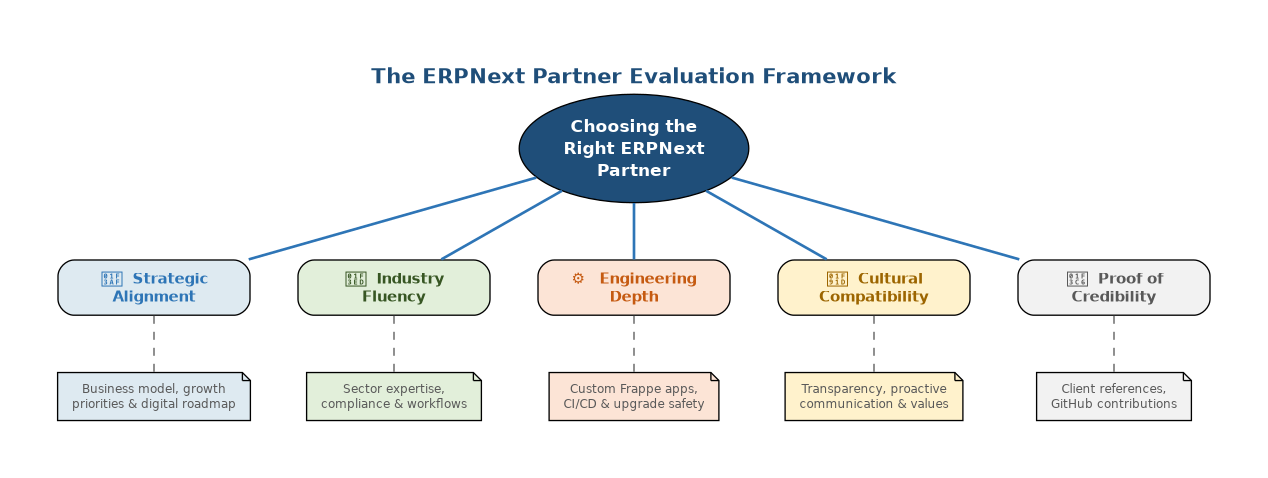
When evaluating any ERPNext partner, alignment across five dimensions determines long-term success — far more than price or demo quality alone.
The Open Source Advantage Nobody Talks About
Frappe Framework powers ERPNext — and it's fully open source, MIT-licensed, and owned by no single company.
Unlike proprietary ERP platforms where you're betting on one vendor's roadmap and paying licensing fees that scale with your headcount, ERPNext evolves through a global community of contributors. This creates compounding advantages:
- No licensing fees — ever. Your cost scales with your business, not with a vendor's pricing model
- No vendor lock-in — you own your data, your code, and your stack completely
- Faster innovation — the platform improves continuously through community contributions, not annual release schedules
- Full transparency — every line of code is auditable; no black boxes in your core business system
But here's the catch: to capture these benefits, you need a partner who truly understands open source — not just one that happens to resell it.
What this looks like in practice:
Top Frappe partners don't just deploy ERPNext. They contribute back to it. They're close to where innovation happens, not reading about it in patch notes months later. They build for portability and shared standards because that's how they think about software.
The Contribution Signal
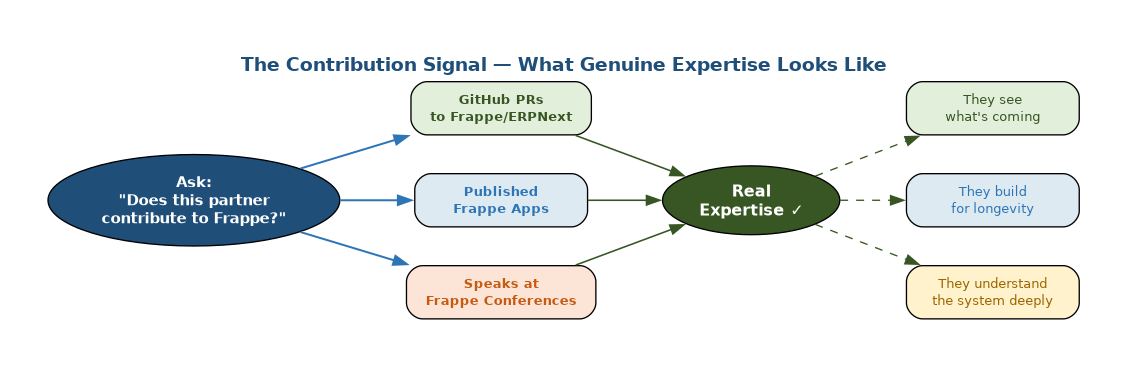
Here's a question most businesses never think to ask: Does this partner contribute back to Frappe/ERPNext?
They should.
In open source, contribution is the strongest signal of genuine expertise. Anyone can install ERPNext. Few organizations invest their own resources in making Frappe better.
When a partner actively contributes to Frappe Framework, ERPNext Core, or the broader ecosystem, you get three practical advantages:
- They see what's coming — their roadmap aligns with Frappe's evolution, not last year's documentation
- They build for longevity — they design for where the platform is headed, not just your current requirements
- They understand the system deeply — contributing to Core means understanding architecture at a level most implementers never reach
What to ask: "Can you show us your GitHub contributions to Frappe or ERPNext? Do you maintain any open-source Frappe apps?"
Look for partners who have published Frappe apps, submitted pull requests to ERPNext, or attend/speak at Frappe conferences.
The Certification and Partnership Filter
Frappe Technologies maintains a formal partner programme with certified implementation partners. These certifications aren't marketing badges — they're earned through demonstrated delivery capability and ongoing training.
What partner tiers signal:
- Verified Frappe Partner — Has completed Frappe's certification process and met minimum delivery standards
- Enterprise Frappe Partner — Higher-tier with proven track record on complex deployments
- Industry specialisation — Some partners focus on manufacturing, healthcare, retail, or education — relevant expertise matters
Beyond certification, look for:
- Custom app portfolio — Purpose-built Frappe apps show they can extend beyond standard ERPNext
- Client references in your industry — ERPNext for a manufacturing company is very different from ERPNext for a services firm
Engineering Excellence: Systems Over Installations
Most IT vendors think in projects. Enterprise-grade ERP partners think in systems.
The difference? Projects have end dates. ERP systems have lifecycles.
They Design for Your Business, Not a Template
ERPNext is not a one-size-fits-all deployment. Out of the box, it covers 15+ modules — but your business has specific workflows, compliance requirements, approval hierarchies, and integrations that require thoughtful configuration and custom development.
Mature partners don't force your business to fit ERPNext. They configure and extend ERPNext to fit your business.
What to look for:
- [ ] Do they conduct a thorough business process mapping exercise before proposing a solution?
- [ ] Can they articulate which requirements need configuration vs. customisation vs. custom development?
- [ ] Do they propose a phased rollout that manages change, or a big-bang go-live that increases risk?
Customisation Philosophy: Extension Over Modification
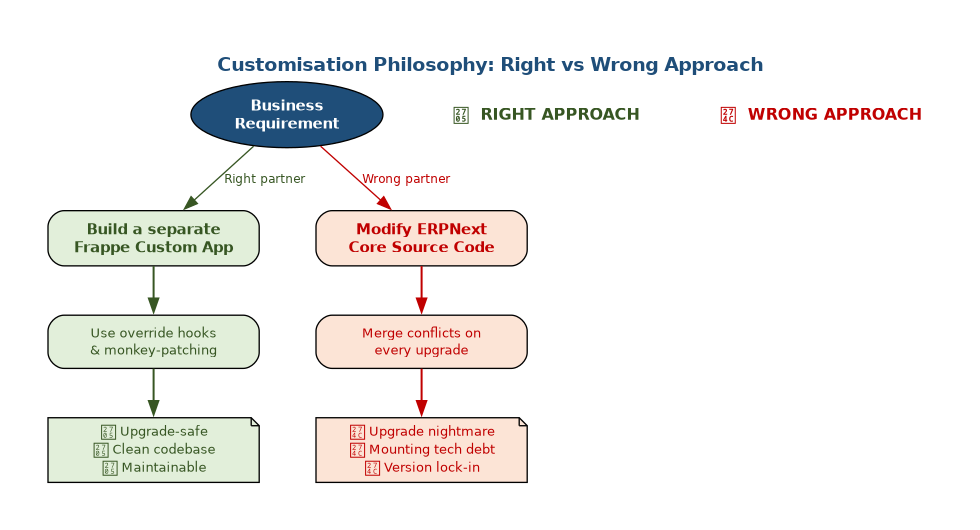
ERPNext's architecture is designed for extension through:
- Custom apps built on Frappe Framework (separate from ERPNext core)
- Custom fields, scripts, and workflows within ERPNext itself
- Hooks and overrides that extend core behaviour without modifying source files
Partners who modify ERPNext's core code directly create upgrade nightmares. Every version upgrade requires manual merging of changes, and over time the system drifts further from the standard codebase.
What to ask: "How do you handle customisations? Do you build a separate custom Frappe app, or do you modify ERPNext source directly?"
The right answer: a separate Frappe app with clean override hooks.
Architectural Foresight Separates Implementation from Engineering
Strong Frappe partners don't design for today's requirements. They anticipate tomorrow's complexity.
They know that early architectural decisions determine how easily you can:
- Add new business entities (companies, branches, warehouses) without re-engineering
- Build custom workflows and approval chains as your organisation grows
- Integrate with third-party tools (payment gateways, logistics APIs, HRMS, BI tools)
- Upgrade ERPNext safely without breaking custom code
- Maintain performance as transaction volumes grow
Red flag: A partner who starts configuring before they fully understand your business is building for today. A partner who asks uncomfortable questions about edge cases, exceptions, and future plans is building for longevity.
Delivery Discipline: Operating Like a Software Team
Great ERP partners operate less like system integrators and more like software engineering organisations.
They use version control (Git) for all configuration and custom code. They maintain separate development, staging, and production environments. They run automated tests before deploying changes. They document what they build.
This discipline means: - Changes are traceable — you can see who changed what and when - Rollbacks are possible — nothing is irreversible - Knowledge isn't locked in one person's head
What to ask: "Can you walk us through your deployment process? Do you use version control for customisations?"
The Track Record That Matters
Engineering philosophy reveals itself through the challenges a partner has successfully navigated. Look for evidence across three types of engagements:
1. Complex Migrations
Many ERPNext journeys begin with replatforming from legacy systems — Tally, SAP Business One, QuickBooks, Microsoft Dynamics, or custom-built solutions.
These aren't just technical migrations. They're strategic resets that redefine how your operations are structured. The best partners ensure:
- Data integrity — chart of accounts, opening balances, historical transactions
- Process continuity — no operational downtime during cutover
- User adoption — people actually use the new system, not workarounds
Ask for references from clients who migrated from a system similar to yours.
2. Multi-Entity and Multi-Site Deployments
ERPNext's multi-company, multi-warehouse, and multi-currency capabilities are powerful — but complex to configure correctly. Partners who have deployed ERPNext across multiple legal entities, branches, or countries have navigated the hard problems: intercompany accounting, consolidated reporting, role-based access across entities, and localisation (GST, TDS, payroll compliance in India).
3. Custom Module Development
Standard ERPNext covers most business functions, but some industries require purpose-built extensions. Healthcare needs patient management. Education needs student lifecycle tracking. Manufacturing needs shop floor control or quality inspection workflows beyond the standard.
Partners who have built and maintained custom Frappe apps — not just configured standard ERPNext — demonstrate a fundamentally different level of technical depth.
The Three Non-Negotiables: Support, Security, and Scalability
Support: What Happens After Go-Live
The go-live is not the finish line. It's the starting line.
Most ERP problems surface in the first 90 days after go-live, when real users encounter real edge cases. The quality of post-go-live support is often the biggest differentiator between a successful ERP implementation and a painful one.
What to evaluate:
- SLA structure — What are the response time commitments for critical issues vs. general queries?
- Support channel — Is support a named person who knows your system, or a generic helpdesk ticket?
- Escalation path — If your issue isn't resolved, what happens?
- Proactive monitoring — Does the partner monitor your system for issues, or do they wait for you to report them?
- Knowledge transfer — Do they train your internal team to handle routine administration, reducing dependency?
Red flag: A partner who is difficult to reach during sales will be impossible to reach after go-live.
Security: Protection as a Layered System
ERPNext holds your most sensitive business data — financials, payroll, customer records, supplier contracts. Security cannot be an afterthought.
Mature partners integrate security into every deployment stage:
- Role-based access control (RBAC) configured correctly from day one — not retrofitted after an incident
- Audit trails enabled so every transaction change is logged with user and timestamp
- Server hardening if self-hosted — firewall rules, SSH access controls, automated backups
- Data encryption for sensitive fields and backup storage
- Regular security reviews as part of the ongoing support relationship
What to ask: "What is your process for configuring user permissions? Can you show us an example of the RBAC structure you've implemented for a similar client?"
Scalability: Built for Where You're Going, Not Just Where You Are
Your business will grow. Transactions will increase. New users will join. New entities may be added. Your ERPNext deployment needs to grow with you — without requiring a complete redesign.
Scalability indicators:
- Frappe Cloud vs. self-hosted guidance — A good partner helps you choose the right hosting model for your scale and budget
- Database optimisation — Are they configuring indexes, archiving old data, and monitoring query performance?
- Customisation architecture — Are customisations built in a way that survives ERPNext version upgrades?
- Upgrade track record — Have they successfully upgraded clients across major ERPNext versions?
The Alignment Framework
| Dimension | What to Evaluate |
|---|---|
| Strategic Alignment | Do they understand your business model, growth priorities, and operational complexity? |
| Industry Fluency | Have they implemented ERPNext for businesses in your sector? Do they understand your compliance and workflow needs? |
| Technical Depth | Can they build custom Frappe apps, not just configure standard ERPNext? Do they use proper dev/staging/production environments? |
| Cultural Compatibility | Do they communicate proactively, document what they build, and treat your team as a partner — not a ticket queue? |
| Proof of Credibility | Do their client references, GitHub contributions, and community presence reflect consistency at scale? |
Questions to Ask in Every Partner Evaluation
Use these questions to cut through sales pitches and assess real capability:
On technical depth: - How do you handle customisations — separate Frappe app or core modification? - Can you show us your Git repository structure for a past project? - How do you manage ERPNext upgrades for clients with customisations?
On implementation process: - What does your business process mapping exercise look like? - How do you handle scope changes mid-project? - What is your data migration methodology?
On support: - What does your post-go-live support contract include? - Who is the named person responsible for our account? - What is your average response time for a critical issue?
On track record: - Can we speak to three clients who went live in the last 12 months? - Have you implemented ERPNext for businesses in our industry? - Have you handled a migration from our current system?
On community and contribution: - Do you contribute to Frappe or ERPNext open source? - Do you maintain any published Frappe apps?
Quick Decision Guide
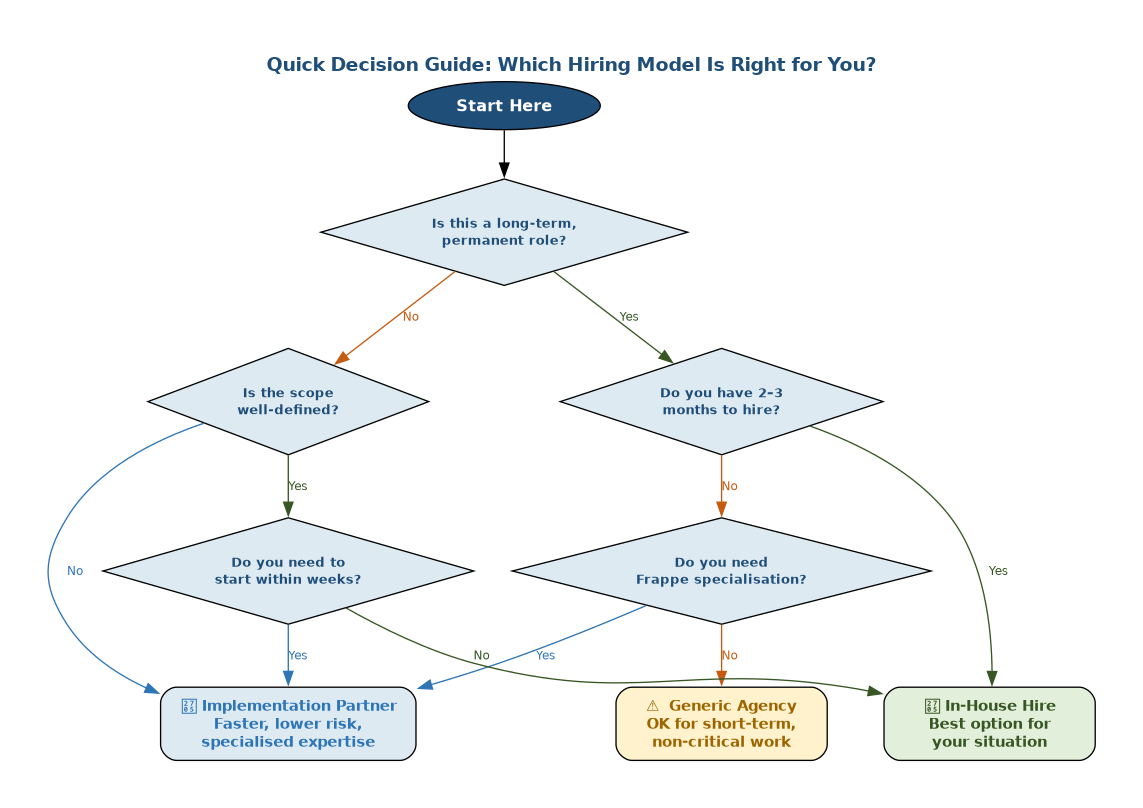
Use this flowchart to quickly anchor your decision on whether to go in-house, hire a generic agency, or partner with a specialist ERPNext firm.
The Bottom Line
Evaluating an ERPNext/Frappe implementation partner comes down to alignment — of technology with business, strategy with execution, and systems with scale.
The right partner doesn't just install ERPNext. They help you build forward, ensuring your ERP platform evolves as your business does: reliable, future-ready, and engineered to last.
Look for partners who contribute to open source, engineer for longevity over speed, operate with software discipline, and stand behind their work with structured post-go-live support.
Hybrowlabs Technologies is a Frappe-certified ERPNext implementation partner with experience across manufacturing, services, healthcare, and education sectors. We build on Frappe Framework with a commitment to clean architecture, proper version control, and long-term client relationships.